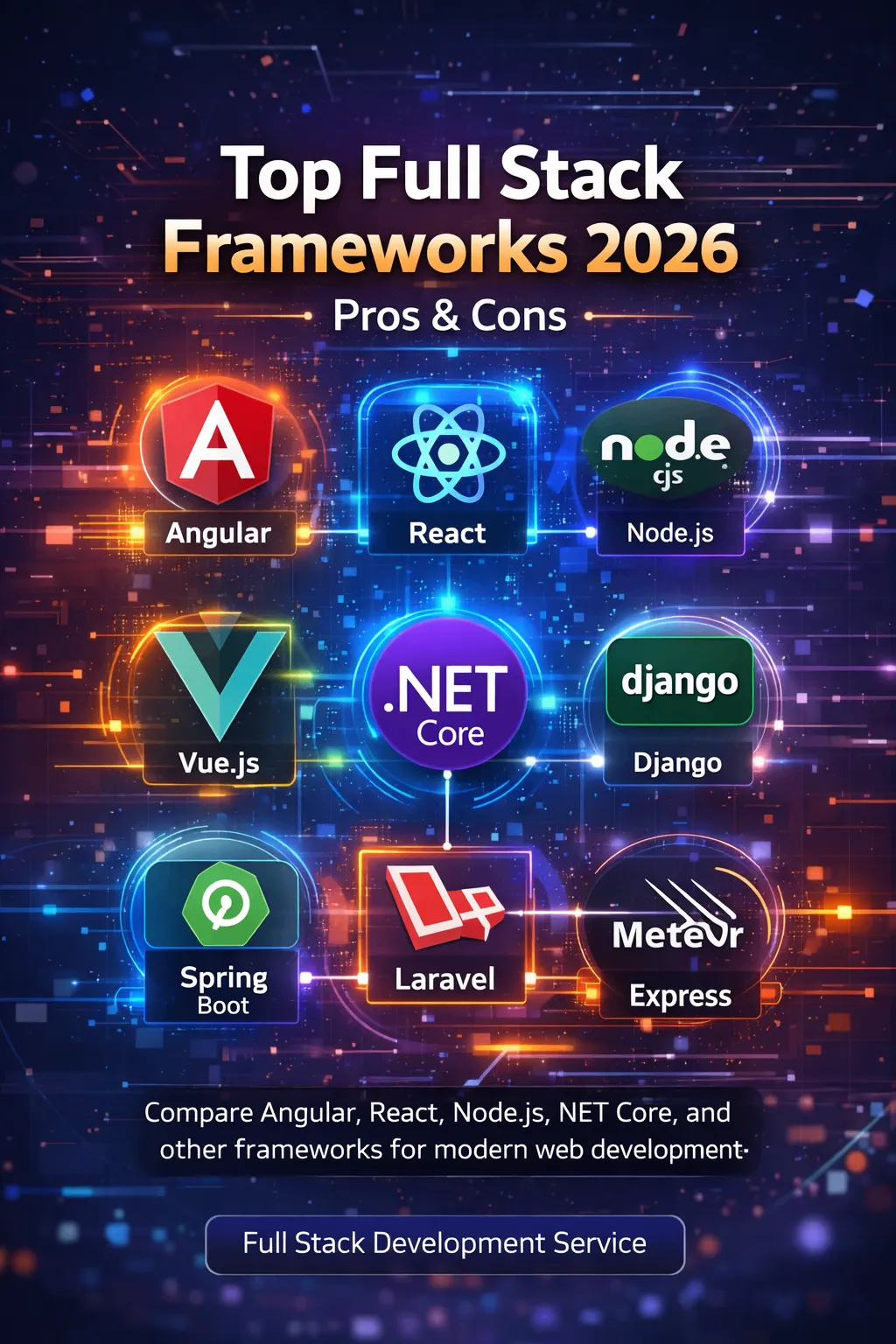
Top 10 Full Stack Frameworks in 2026
(Pros & Cons)
Introduction
In 2026, businesses demand fast, scalable, and maintainable web applications. Choosing the right full stack framework is crucial for achieving these goals. Whether you’re a startup, enterprise, or an independent developer, knowing the pros and cons of top frameworks helps you make informed decisions for your projects.
This guide compares Angular, React, Node.js, .NET Core, and other popular frameworks to help you select the best tools for modern web development.
Table of Contents
What Is a Full Stack Framework?
A full stack framework provides tools, libraries, and best practices to develop both frontend and backend components of a web application. Using a unified framework or stack ensures:
Faster development
Easier maintenance
Better integration between client-side and server-side
Scalability for future growth
Full stack frameworks often combine frontend libraries like Angular or React with backend platforms such as Node.js or .NET Core.
Top 10 Full Stack Frameworks in 2026
1. Angular
Pros:
Powerful frontend development with two-way data binding
Strong TypeScript support for scalable apps
Rich ecosystem of tools and modules
Cons:
Steeper learning curve for beginners
Can be verbose for small projects
Use Case: Enterprise dashboards, e-commerce platforms
2. React
Pros:
Component-based architecture
Fast rendering with virtual DOM
Large community and third-party libraries
Cons:
Only handles frontend; requires backend integration
Frequent updates can break older code
Use Case: Dynamic single-page applications, mobile apps with React Native
3. Node.js
Pros:
Handles server-side logic with JavaScript
Non-blocking, asynchronous architecture
Great for real-time apps
Cons:
Callback-heavy code can become complex
Single-threaded nature may not suit CPU-intensive apps
Use Case: APIs, real-time chats, SaaS platforms
4. .NET Core
Pros:
High performance and security
Cross-platform support
Integration with Azure and enterprise tools
Cons:
Requires C# knowledge
Less flexible for lightweight projects
Use Case: Enterprise applications, ERP systems, cloud-based platforms
5. Vue.js
Pros:
Lightweight and beginner-friendly
Reactive data binding
Easy integration with backend frameworks
Cons:
Smaller ecosystem compared to React/Angular
Limited corporate adoption
Use Case: Startups, small to medium web apps
6. Django + Python
Pros:
Fast backend development with Python
Built-in admin interface
Scalable and secure
Cons:
Learning curve for Python beginners
Not ideal for highly dynamic frontend
Use Case: SaaS platforms, content-heavy websites
7. Spring Boot + Java
Pros:
Enterprise-level backend framework
Strong security and performance
Microservices-ready
Cons:
Verbose syntax
Steeper learning curve for frontend integration
Use Case: Large enterprise systems, banking apps
8. Laravel + PHP
Pros:
Easy backend setup for web apps
Built-in authentication and routing
Active developer community
Cons:
PHP may be less trendy for modern apps
Can be slower than Node.js or .NET
Use Case: E-commerce, content management systems
9. Express.js + Node.js
Pros:
Lightweight server framework
Flexible and minimalistic
Integrates seamlessly with MongoDB (MERN stack)
Cons:
Requires additional libraries for full features
Less opinionated structure can confuse beginners
Use Case: APIs, real-time apps, microservices
10. Meteor.js
Pros:
Full stack JavaScript framework
Real-time data synchronization
Rapid prototyping
Cons:
Smaller community than Angular/React
Less flexible for large-scale enterprise apps
Use Case: Startups, real-time apps, MVPs
How to Choose the Right Full Stack Framework in 2026
Project Size & Complexity: Enterprise apps may benefit from .NET Core or Spring Boot, while startups prefer Vue.js or Meteor.js.
Team Expertise: Leverage frameworks your team knows well to reduce learning curves.
Performance Needs: For real-time apps, Node.js or Express.js is ideal.
Community & Support: Popular frameworks like React and Angular offer strong community support and resources.
Conclusion
Selecting the right full stack framework in 2026 can make or break your project. From Angular and React for dynamic frontends to Node.js and .NET Core for robust backends, each framework has unique strengths and trade-offs. Evaluate your project needs, team skills, and scalability requirements before choosing a framework.
Comparison Table: Best Full Stack Frameworks 2026
| Framework | Type | Performance | Scalability | Learning Curve | Best For | Ideal Use Case |
|---|---|---|---|---|---|---|
| Angular | Frontend | High | High | Moderate–High | Enterprise Apps | Large dashboards, ERP systems |
| React | Frontend Library | Very High | High | Moderate | Dynamic UI Apps | SPAs, mobile apps |
| Node.js | Backend Runtime | Very High (I/O) | High | Moderate | Real-time Apps | APIs, chat apps, SaaS |
| .NET Core | Backend Framework | Very High | Very High | Moderate | Enterprise Systems | Banking, ERP, Cloud apps |
| Vue.js | Frontend | High | Medium | Easy | Startups | Lightweight web apps |
| Django | Backend Framework | High | High | Moderate | Secure Apps | SaaS, CMS platforms |
| Spring Boot | Backend Framework | Very High | Very High | High | Large Enterprises | Financial systems |
| Laravel | Backend Framework | Medium–High | Medium | Easy | SMBs | E-commerce sites |
| Express.js | Backend Framework | High | High | Easy | APIs | Microservices |
| Meteor.js | Full Stack JS | Medium–High | Medium | Easy | MVPs | Rapid prototyping |
🚀 Ready to develop a modern, scalable application? Contact SherdilPro Tech Solutions for custom full stack development services and expert guidance in 2026!