
Azure vs AWS vs Google Cloud: Which is Best for Your Project?
Cloud computing has transformed the way businesses operate. Today, companies rely on cloud platforms to host applications, store data, and scale services efficiently. Among the top cloud providers, Microsoft Azure, Amazon Web Services (AWS), and Google Cloud Platform (GCP) dominate the market. But which one is best for your project? This comprehensive guide compares these three cloud giants to help you make an informed decision.
Table of Contents
What is Cloud Computing?
Before diving into comparisons, let’s understand cloud computing.
Cloud computing refers to delivering computing services—such as servers, storage, databases, networking, software, analytics, and intelligence—over the Internet (“the cloud”) instead of on local computers or on-premises servers.

Key Benefits of Cloud Computing:
Cost Efficiency: Pay only for what you use.
Scalability: Scale resources up or down based on demand.
Flexibility: Access services from anywhere.
Reliability: High uptime and disaster recovery options.
Cloud computing has three main service models:
IaaS (Infrastructure as a Service) – Virtual machines, storage, networks.
PaaS (Platform as a Service) – Managed platforms for app development
SaaS (Software as a Service) – Ready-to-use software delivered over the cloud.
Overview of Azure, AWS, and Google Cloud
Here’s a quick introduction to the three major cloud platforms:
Microsoft Azure
Azure is Microsoft’s cloud platform offering a wide range of services, including computing, networking, databases, analytics, AI, and IoT solutions. Its integration with Microsoft tools like Office 365, Windows Server, and Active Directory makes it popular among enterprises.
Amazon Web Services (AWS)
AWS is the pioneer and largest cloud provider globally. It offers a massive portfolio of services, including computing power, storage, machine learning, and content delivery. AWS is known for its reliability, scalability, and extensive global presence.
Google Cloud Platform (GCP)
GCP is Google’s cloud offering, known for its data analytics, AI, and machine learning capabilities. It is designed for modern applications that require high-speed processing, big data analytics, and serverless computing.
Comparing Azure, AWS, and Google Cloud
To determine which platform is best for your project, consider these crucial factors:
1. Service Offerings
| Feature | AWS | Azure | Google Cloud |
|---|---|---|---|
| Compute | EC2, Lambda | Virtual Machines, Azure Functions | Compute Engine, Cloud Functions |
| Storage | S3, Glacier | Blob Storage, File Storage | Cloud Storage, Persistent Disk |
| Databases | RDS, DynamoDB | SQL Database, Cosmos DB | Cloud SQL, Firestore |
| AI & ML | SageMaker | Azure AI, Machine Learning | Vertex AI, TensorFlow |
| Networking | VPC, CloudFront | Virtual Network, ExpressRoute | VPC, Cloud CDN |
Key Insight:
AWS has the broadest set of services and features.
Azure is highly integrated with Microsoft ecosystems.
GCP excels in AI, ML, and data analytics.
2. Pricing Comparison
Pricing is often the most important factor for startups and small businesses.
AWS: Pay-as-you-go, with free tiers for new users. Pricing can be complex due to many services.
Azure: Competitive pay-as-you-go, discounts for Microsoft software users.
GCP: Flexible pricing, sustained-use discounts, and per-second billing make it cost-efficient for continuous workloads.
Tip: Consider your project type and workload when comparing pricing, as cloud bills can vary significantly depending on usage.
3. Performance and Global Reach
| Cloud | Global Regions | Edge Locations | Performance Strength |
|---|---|---|---|
| AWS | 31 regions | 400+ | Best for high-availability apps |
| Azure | 30 regions | 200+ | Enterprise apps, hybrid cloud |
| GCP | 29 regions | 150+ | Big data, AI workloads |
Key Insight:
AWS is ideal for global reach and multi-region deployments.
Azure is strong for hybrid cloud solutions.
GCP shines in high-speed, data-intensive applications.
4. Security and Compliance
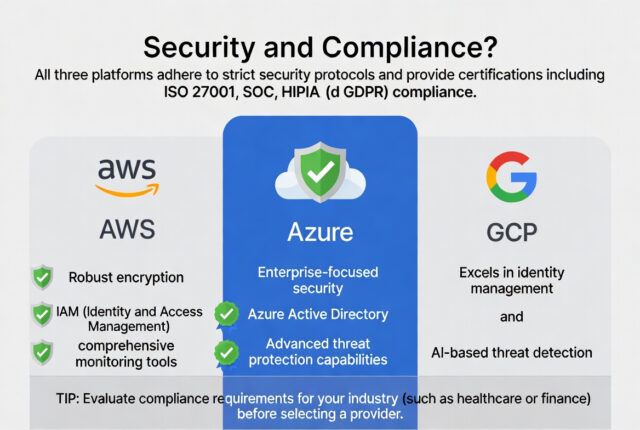
protocols and offer certifications such as ISO 27001, SOC, HIPAA, and GDPR compliance.
AWS: Offers robust encryption, IAM, and monitoring tools.
Azure: Enterprise-focused security with Azure Active Directory and advanced threat protection.
GCP: Strong in identity management and AI-based threat detection.
Tip: Evaluate compliance requirements for your industry (e.g., healthcare, finance) before choosing a provider.
5. Integration and Ecosystem
AWS: Wide integration with third-party services.
Azure: Deep integration with Microsoft products, ideal for Windows-based businesses.
GCP: Best for Google ecosystem (Workspace, BigQuery, TensorFlow).
Key Insight: Choose a cloud provider that aligns with your existing software stack to save time and reduce compatibility issues.
6. Ease of Use
AWS: Powerful but complex interface; requires learning curve.
Azure: User-friendly for enterprises familiar with Microsoft tools.
GCP: Simplified, developer-friendly, excellent for data scientists.
Tip: Teams with strong DevOps experience may prefer AWS, while data teams may favor GCP.
7. Hybrid and Multi-Cloud Strategy
Many organizations adopt hybrid or multi-cloud approaches to maximize flexibility:
Azure: Strong hybrid cloud solutions with Azure Arc and Stack.
AWS: Supports hybrid but primarily public cloud-focused.
GCP: Multi-cloud capabilities via Anthos, suitable for containerized applications.
Key Insight: If your project needs hybrid cloud support, Azure or GCP is a better choice.
Use Cases for Each Cloud Platform
Understanding real-world use cases helps in choosing the right platform.
Best for Enterprise Applications – Azure
Integrates with Microsoft 365, Dynamics, and Windows Server.
Ideal for companies already using Microsoft tools.
Best for Startups & Scalability – AWS
Offers a broad range of services, global reach, and flexibility.
Perfect for startups with unpredictable workloads.
Best for Big Data & AI Projects – Google Cloud
BigQuery, Vertex AI, and TensorFlow make it ideal for AI, ML, and analytics-heavy applications.
Preferred by data-driven companies and tech innovators.
Pros and Cons of Each Cloud Platform
AWS
Pros:
Largest market share and service variety
Excellent scalability and performance
Mature ecosystem
Cons:
Complex pricing
Steep learning curve for beginners
Azure
Pros:
Seamless Microsoft integration
Strong enterprise features
Hybrid cloud support
Cons:
Can be expensive without proper planning
Limited developer-focused tools compared to GCP
Google Cloud
Pros:
Best for AI, ML, and big data
Transparent and flexible pricing
Simple and developer-friendly
Cons:
Smaller market share
Fewer services compared to AWS
How to Choose the Right Cloud Platform
Choosing the right cloud depends on:
Project Type: Enterprise app, AI project, web app, or hybrid solution.
Budget: Consider long-term pricing and discounts.
Skillset: Team expertise in AWS, Azure, or GCP.
Integration Needs: Existing software stack and workflows.
Scalability & Performance: Anticipated user base and global reach.
Quick Decision Guide:
Azure: For enterprises using Microsoft ecosystem.
AWS: For large-scale, flexible, and global applications.
GCP: For AI, machine learning, and data-driven projects.
Conclusion
Choosing between Azure, AWS, and Google Cloud requires careful analysis of your project requirements, budget, and technical expertise.
Azure excels in enterprise environments and hybrid solutions.
AWS offers unmatched service variety, scalability, and global presence.
GCP is perfect for AI, ML, and data-intensive applications.
Ultimately, there’s no one-size-fits-all answer. The best cloud platform is the one that aligns with your project goals, team expertise, and future growth plans.
Next Steps:
Evaluate your current infrastructure and software stack.
Run small pilot projects on different platforms.
Analyze performance, cost, and ease of management before full-scale adoption.
⭐ Build Smarter Projects with the Right Cloud
The right cloud platform can save money, improve performance, and scale your business faster.
Compare your needs, test the platforms, and start building today.